

| 70%Time Reduction | 3 hrsInstead of 3 Days | 5–10People Freed Up |
For Executives, Operations Leaders & Decision-Makers
Executive Summary
A 22-person technical consulting firm was spending 2–3 full business days and 5–10 team members just to read, cross-reference, and process 100–200 pages of documents before any actual work could begin.
That document processing alone was costing the firm $78,000–$195,000 per month in labor. Employee burnout was driving 35% annual turnover. Clients were waiting days for deliverables that should have taken hours.
After deploying an agentic AI solution, the same work now takes approximately 3–4 hours with just 1–2 people reviewing the AI’s output.
| Metric | Before AI | After AI |
|---|---|---|
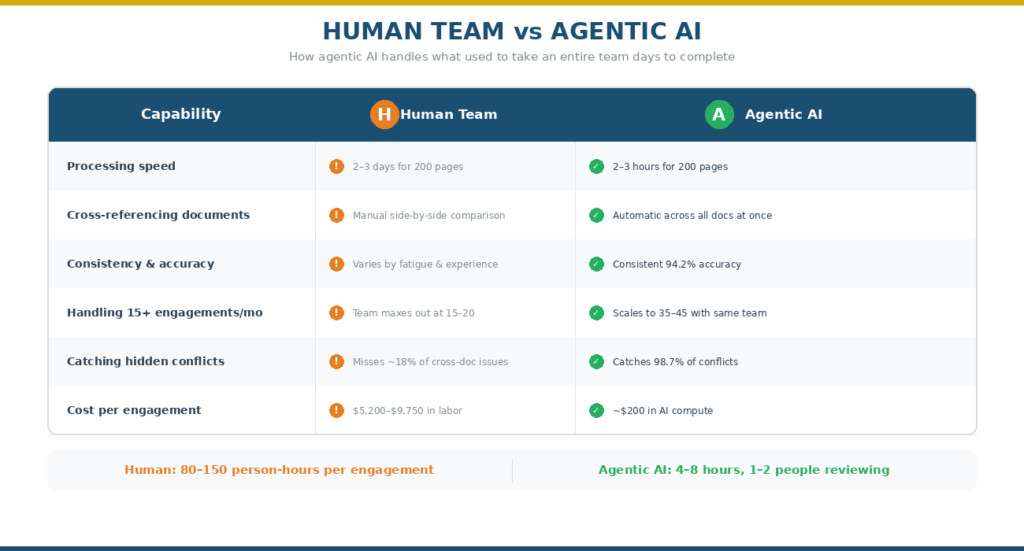
| Time per engagement | 2–3 days | 3–4 hours |
| People required | 5–10 people | 1–2 people |
| Person-hours consumed | 80–150 hrs | 4–8 hrs |
| Monthly labor cost | $78K–$195K | $22K–$35K |
| Employee turnover | 35% annually | 8% annually |
| Client satisfaction | 7.8 / 10 | 9.1 / 10 |
ROI payback: under 5 weeks. No employees were laid off. The same team now handles 2.5x more engagements and spends 70% of their time on high-value advisory work instead of reading.
Who Should Read This — and Why It Matters to You
This case study is written for business owners, COOs, VPs of Operations, and anyone who manages teams that spend large portions of their week reading, reviewing, or processing documents. If your people are buried in paperwork before they can do the work they were actually hired to do, this story is directly relevant to your bottom line.
You do not need a technical background to understand this case study. Every concept is explained in plain business language, and every claim is backed by measurable data.
Part 1: The Problem Nobody Budgets For
“We were paying our best analysts six figures to do something a photocopier could almost do & turn pages.” — Adam Tanjil, Founder & CEO
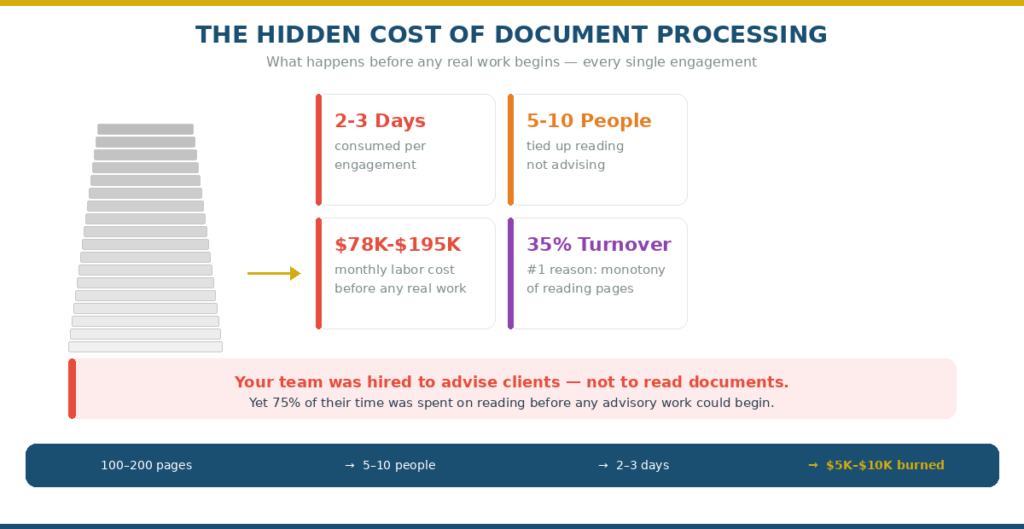
Every morning at 7:30 AM, the eight-person operations team at our partners organization, a small regulatory consulting firm would gather around a conference table stacked with paper. Contracts, audit reports, assessments, certifications, regulatory filings.
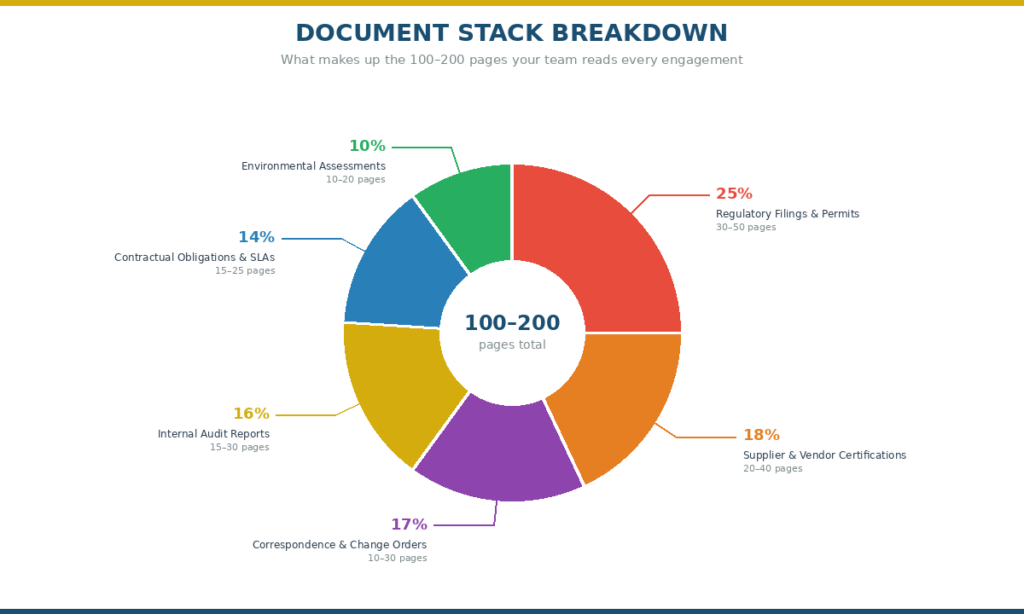
Each client engagement required the team to manually read, cross-reference, and analyze between 100 and 200 pages of dense documentation before they could even begin their actual work. This is the hidden tax that thousands of small businesses pay every single day.
What Does “100–200 Pages Per Operation” Actually Look Like?
Here is the typical document stack for a single client engagement. These are not optional — every page must be read, understood, and cross-referenced before any recommendations can be made:
The Human Workflow: 5 Painful Steps
Here’s the part that should make every operations leader uncomfortable: this workflow hadn’t changed in over a decade.
The team followed a five-phase process for every single engagement. Each phase had to finish before the next could begin:
| # | Phase | What Happened | Time | People |
|---|---|---|---|---|
| 1 | Initial Triage | Senior analyst skims all docs, identifies scope | 3–4 hrs | 1 |
| 2 | Deep Reading | Team divides docs, reads assigned sections in full | 6–8 hrs | 5–10 |
| 3 | Cross-Referencing | Team meets to compare notes, find conflicts | 4–6 hrs | 5–10 |
| 4 | Data Extraction | Key data points manually entered into spreadsheets | 3–5 hrs | 2–4 |
| 5 | Verification | Second analyst re-reads critical sections to verify | 2–4 hrs | 1–2 |
| TOTAL | Full document processing cycle | 2–3 days | 5–10 |
The True Cost: More Than Just Hours
The labor cost was staggering. But the hidden costs were worse.
| Cost Category | Impact |
|---|---|
| Direct labor cost per engagement | $5,200 – $9,750 |
| Monthly processing cost (15–20 engagements) | $78,000 – $195,000 |
| Recruiting & onboarding cost per replacement | ~$18,000 per analyst |
| Client wait time for deliverables | 3–5 business days (vs. industry expectation of 1–2) |
| Revenue ceiling (limited by throughput) | Firm could not accept more than 20 engagements/mo |
At an average fully-loaded cost of ~$30-50/hour per analyst, each engagement consumed $5,200–$9,750 in labor before any value-generating work began. For a company with annual revenue under $5 million, this was an existential problem disguised as an operational one.
Part 2: What Is Agentic AI? (The Non-Technical Explanation)
Think of it this way: Agentic AI is an employee.
Agentic AI works like a skilled junior employee. You give it a goal (“review this 180-page compliance package and identify all regulatory gaps”), and it autonomously plans and executes a series of steps to achieve that goal. It can read a document, decide it needs more context, go read another document, compare the two, identify a discrepancy, flag it, and then continue processing, all without you intervening at each step.
Part 3: The Solution — How It Actually Works
The system doesn’t just read faster. It reads smarter. Here’s the step-by-step.
The implementation took 8 weeks from design to production. The system uses four specialized AI “agents” that work together like a well-coordinated team — each with a specific role, passing their work to the next.
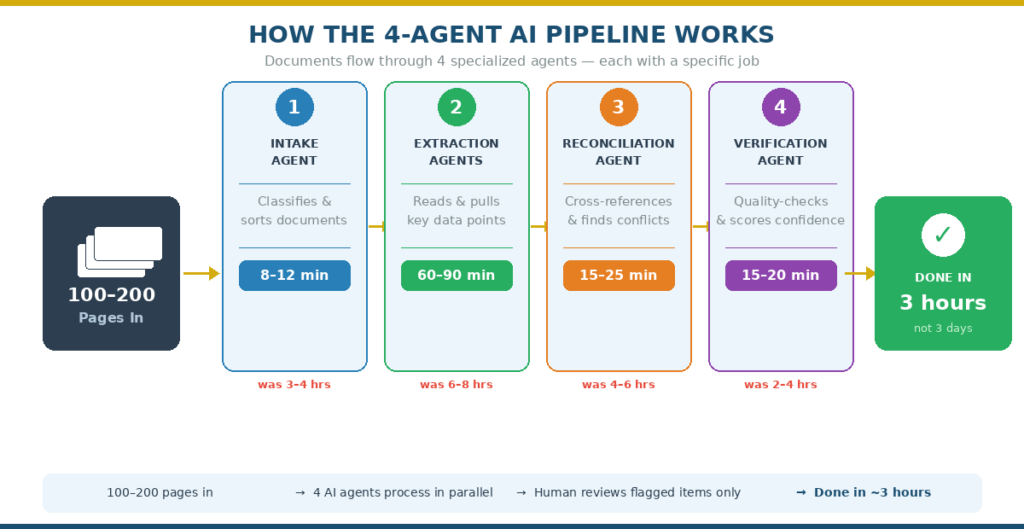
The 4-Agent Pipeline (How Documents Flow Through the System)
| Step | Agent | What It Does (In Plain English) | Time | Replaces |
|---|---|---|---|---|
| 1 | Intake Agent | Reads the first few pages of every document, figures out what type it is, puts them in the right order, and flags anything missing or incomplete | 8–12 min | 3–4 hrs |
| 2 | Extraction Agents | Specialized readers for each doc type (contracts, audits, permits, correspondence). Pull out every key date, obligation, risk, and requirement | 60–90 min | 6–8 hrs |
| 3 | Reconciliation Agent | Compares everything found across ALL documents. Finds conflicts, gaps, and inconsistencies that humans often miss | 15–25 min | 4–6 hrs |
| 4 | Verification Agent | Quality-checks everything. Goes back to source documents to confirm accuracy. Flags anything below 85% confidence for human review | 15–20 min | 2–4 hrs |
| TOTAL | Complete document processing cycle | ~2–3 hrs | 2–3 days |
The Critical Design Decision: Humans Stay in the Loop
The AI doesn’t make decisions. Your people do. The AI just makes sure they have everything they need — in hours, not days.
Every item flagged with less than 85% confidence goes to a human analyst for review. This is not a limitation — it is the single most important design choice in the entire system. In a compliance context, a wrong answer is worse than a slow answer. The system is deliberately tuned to over-flag rather than under-flag. A false alarm reviewed in 5 minutes is far less costly than a missed compliance gap discovered during a regulatory audit.
Part 4: A Day in the Life — Before vs. After
This is where the numbers become real. Same team, same client, same 175-page document package. Two completely different Mondays.
| Time | Before (Monday 2024) | After (Monday 2026) |
|---|---|---|
| 8:00 AM | Receive 175-page engagement package | Receive 175-page engagement package |
| 8:15 AM | Senior analyst begins triage | Analyst uploads docs to AI pipeline |
| 8:25 AM | Still reading… | Intake Agent classifies all documents |
| 9:45 AM | Still reading… | Extraction agents finish deep reading |
| 10:10 AM | Still reading… | Reconciliation Agent flags 12 items |
| 11:30 AM | Still reading… | Analyst confirms findings. DONE. ✓ |
| 12:00 PM | Senior analyst finishes triage, assigns sections to 6 team members | Team begins advisory work over lunch |
| Tue–Wed | Deep reading, cross-referencing, extraction, verification continues… | Team works on next engagement |
| Wed 2 PM | FINALLY DONE. | Third engagement of the week underway |
Part 6: The Results — Hard Numbers, No Fluff
47 engagements. 90-day pilot. Every metric tracked. Here’s what happened.
| 70.8%Faster Per Engagement | 94%Less Human Labor | 62%Revenue Per Employee ↑ |
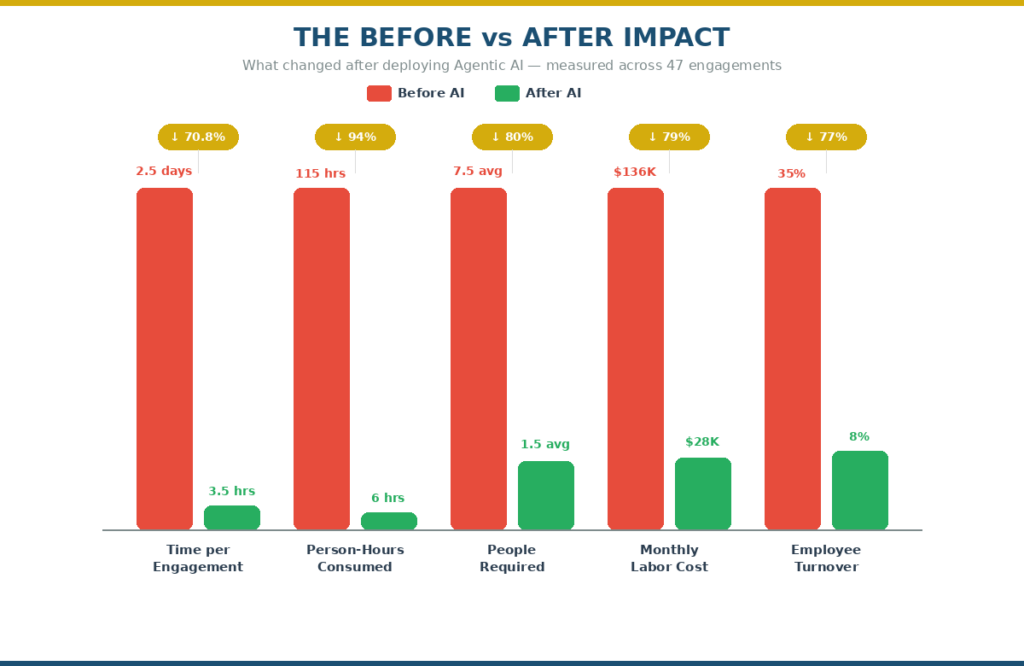
Detailed Performance Metrics
| Metric | Before | After | Change |
|---|---|---|---|
| Elapsed time per engagement | 2.5 days (20 hrs) | 3.5 hours | ↓ 70.8% |
| Person-hours per engagement | 80–150 hrs | 4–8 hrs | ↓ 94% |
| People required per engagement | 5–10 | 1–2 | ↓ 80% |
| Monthly engagement capacity | 15–20 | 35–45 | ↑ 125% |
| Revenue per employee | Baseline | +62% | ↑ 62% |
| Client satisfaction score | 7.8 / 10 | 9.1 / 10 | ↑ 17% |
| Employee turnover (annual) | 35% | 8% | ↓ 77% |
| Time on high-value advisory work | 25% | 70% | ↑ 180% |
Accuracy Report Card
The AI wasn’t just faster. It was more thorough than the human team — catching things experienced analysts missed.
| Accuracy Metric | AI System | Human Team |
|---|---|---|
| Overall extraction accuracy | 94.2% | Baseline (expert) |
| Critical items missed (false negatives) | 1.8% | 4.1% |
| False alarms (false positives) | 6.3% | 2.7% |
| Cross-document conflicts detected | 98.7% | ~82% |
Key insight: The AI system has a higher false positive rate (6.3% vs 2.7%) — meaning it flags more items that turn out to be fine. This is by design. In compliance, a false alarm reviewed in 5 minutes is infinitely preferable to a missed violation discovered during an audit. The AI’s false negative rate (critical items missed) was less than half the human team’s.
Part 6: The ROI — Show Me the Money
Payback in under 5 weeks. That’s not a projection. That’s what actually happened.
Here’s the full financial picture, with nothing hidden. These are the numbers any CFO or business owner needs to make an informed decision.
Investment Required
| Cost Item | Amount |
|---|---|
| Initial setup, configuration & training | $45,000 (one-time) |
| Monthly platform, compute & maintenance | $3,200 / month |
| Annual ongoing cost | ~$38,400 / year |
| Total Year 1 Investment | ~$83,400 |
Savings Generated
| Category | Before (Monthly) | After (Monthly) |
|---|---|---|
| Document processing labor | $78K–$195K | $22K–$35K |
| AI platform cost | $0 | $3,200 |
| Net monthly cost | $78K–$195K | $25K–$38K |
| NET MONTHLY SAVINGS | $53,000 – $160,000 | |
ROI Summary
| <5 wksPayback Period | 8–23xAnnual ROI | $636K–$1.9MAnnual Savings |
Even at the most conservative estimate, the system pays for itself in under five weeks and generates over $600,000 in annual savings. At the higher end, the return exceeds $1.9 million annually against an $83,400 total first-year investment.
Part 7: Employee Impact — The Story Behind the Numbers
“For the first time in three years, I’m doing the work I was actually hired to do.” — Senior Analyst, Meridian
No one lost their job. This point cannot be emphasized enough. Every analyst who was previously spending their days reading documents is now spending their days advising clients, building relationships, and delivering the strategic guidance that Meridian’s clients actually pay for.
| Employee Metric | Before | After |
|---|---|---|
| Time on advisory / high-value work | 25% | 70% |
| Time on document reading | 75% | 15% |
| Annual turnover | 35% | 8% |
| Job satisfaction (internal survey) | 5.2 / 10 | 8.7 / 10 |
| % recommending firm as employer | 41% | 91% |
Part 8: Five Lessons Every Business Leader Should Take Away
These lessons cost Meridian $120,000 in failed attempts and 8 weeks of implementation to learn. You get them for free.
| # | Lesson | What This Means for You |
|---|---|---|
| 1 | Map the workflow first | Spend 2 weeks documenting every step of your current process — including the informal ones. AI can only automate what you can describe. |
| 2 | Define accuracy thresholds upfront | Decide before deployment what confidence level triggers human review. Meridian chose 85%. This prevents silent errors that destroy trust. |
| 3 | Augment, don’t replace | The goal is to make your existing team 3x more productive — not to eliminate headcount. Your people’s expertise is what makes the AI’s output valuable. |
| 4 | Run parallel for 30 days | Let your team compare AI results to human results side-by-side. Nothing builds trust faster than seeing the AI catch something they missed. |
| 5 | Measure what surprises you | Meridian expected faster turnaround. They didn’t expect improved client satisfaction or reduced turnover. Track everything — the unexpected wins justify the investment. |
Part 9: Is This Right for Your Business?
Not every business needs this. But if you recognize yourself in this checklist, you probably do.
You Are a Strong Candidate If…
Your team regularly processes 50+ pages of documents per operation or client engagement. You have 5+ people involved in document review for each engagement. The same types of documents appear in every engagement (even if the content differs). Your people spend more time reading than doing the work they were hired for. You have tried basic automation or AI tools and found them insufficient. Accuracy and compliance are non-negotiable in your industry.
Industries Where This Applies
| Industry | Typical Document Load | Potential Time Savings |
|---|---|---|
| Legal / Law Firms | Contract review, case files, discovery | 60–75% |
| Accounting / Audit | Financial statements, tax filings, work papers | 50–70% |
| Healthcare | Patient records, insurance claims, compliance | 55–70% |
| Insurance | Claims, policy documents, underwriting | 60–75% |
| Real Estate | Titles, inspections, contracts, disclosures | 50–65% |
| Logistics / Supply Chain | Shipping docs, customs, certifications | 55–70% |
| Government / Public Sector | Grant applications, regulatory filings, reports | 50–65% |
The Bottom Line
Three days became three hours. Eight people reading became one person reviewing. A team drowning in paper rediscovered the work they signed up to do.
The story of Meridian is not a story about artificial intelligence. It is a story about operational leverage — about giving a small team the capacity of one three times its size without adding a single person.
For the thousands of small businesses that spend disproportionate amounts of their limited human capital on reading and processing documents, agentic AI represents something genuinely transformative. Not because it reads faster than humans. But because it reads systematically, cross-references automatically, flags discrepancies reliably, and frees your best people to do their best work.
That’s not automation. That’s liberation.
Have questions about whether agentic AI fits your document-heavy operations? Reach out to discuss your specific workflow and potential ROI.